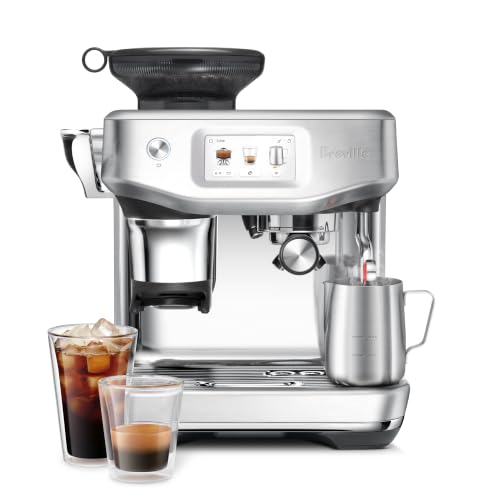
The Breville Barista Touch Impress sits at the top of Breville’s semi-automatic home espresso lineup. It pairs a built-in grinder, a touchscreen that coaches you through each drink, an assisted tamping system and a steam wand that textures milk on its own. The pitch is simple: café-style espresso drinks from whole beans, with most of the skill built into the machine instead of left to you. This page goes through what Breville says about it, who it suits, and where another machine on our list would serve you better. For the full field, see our ranking of the best espresso machines of 2026.
We have not handled this machine and take no measurements of our own. Everything below comes from Breville’s published product page and general knowledge of how this type of machine works.
What Kind of Machine It Is
Espresso machines split into a few families. Super-automatics grind, dose, tamp, brew and often froth milk with one button. Pod machines trade control for convenience. Semi-automatics, like this one, still ask you to take part: you lock in a portafilter, pull the shot and handle the milk jug. The Barista Touch Impress is a semi-automatic that automates as many of those steps as Breville can fit into the design while keeping a real portafilter and a real steam wand.
That middle position is the point. You get the flavor control that comes from freshly ground beans and a proper basket, but the machine handles the steps that trip up beginners: dose, tamp pressure and milk texture. If you want more manual control, the Gaggia Classic Evo Pro sits at the other end of the spectrum. If you want zero involvement, a super-automatic such as the Jura E8 handles the whole sequence.
The Grinder and the Impress Puck System
According to Breville, the machine has an integrated Baratza conical burr grinder with hardened steel burrs and 30 grind settings. Thirty steps is a fine range, and it matters because grind size is the single biggest variable in espresso. Too coarse and the shot runs thin and sour; too fine and it chokes and turns bitter. Beans age, rooms change in humidity, and a new bag of a darker or lighter roast often needs a small adjustment, so a wide range of settings is useful.
The Impress Puck System is the headline feature. Breville describes it as intelligent dosing, assisted tamping at 22 lb, and a 7 degree barista twist finish. In practice that means the grinder delivers a dose into the portafilter, you pull a lever to press the puck with a consistent force, and the machine finishes it with a small polish motion. Breville also says the system automatically corrects the next dose, which implies it learns from the result of the previous shot. The target is to remove the two most common beginner errors: uneven tamping and the wrong amount of coffee in the basket.
Breville also lists a precision trimming tool, which it calls the Razor, in the accessories. It is used to level the dose in the basket before brewing, a habit that seasoned home baristas follow for repeatable shots.
Heating, Brewing and Cold Extraction
The machine uses Breville’s ThermoJet heating system. Breville states that it reaches the target extraction temperature in 3 seconds. Fast heat-up matters in a kitchen: you do not have to switch the machine on ten minutes before your first cup. Breville also says ThermoJet uses up to 32 percent less annual energy than a Thermoblock system, based on its own internal figures, so treat that as a manufacturer claim.
The page highlights what Breville calls a “4 keys” approach to espresso: dose, temperature control, pressure and microfoam. The machine addresses the first with the grinder and puck system, the second with ThermoJet and the third through its brewing system. The fourth, microfoam, is the job of the steam wand.
There is also a Cold Extraction function. Breville lists cold brew in under 3 minutes and cold espresso in just under 2 minutes. If you drink iced lattes through the summer, that is a real convenience, though it is a different style of drink from slow-steeped cold brew that sits for hours.
Milk: Auto MilQ
Milk is where many home machines lose people. Auto MilQ is Breville’s hands-free steam wand system. According to Breville, it produces microfoam with settings for dairy, soy, almond and oat milk, adjustable temperature from 104°F to 167°F, and 8 texture levels. You set the drink on the screen, place the stainless steel jug under the wand and let the machine run.
That wide temperature range is useful in a household with different preferences. A warm flat white and a very hot latte can come from the same jug with different settings. Plant-based milks behave differently from dairy because they have less protein and fat, which is why a dedicated setting for oat or almond is a reasonable feature rather than a gimmick. Breville includes a 16 oz (480 ml) stainless steel jug, which suits one large latte or two small drinks.
Auto-texturing is convenient, but it does not remove cleanup. The wand needs wiping after each use, and Breville supplies a steam wand cleaning tool for the tip. If you want to learn manual latte art, the automation can feel limiting, and a manual wand is a better teacher.
The Touchscreen and Drink Presets
The touchscreen gives step-by-step barista guidance and real-time feedback. Breville lists 13 café presets and says you can customize up to 6 drinks. That is a sensible split: the presets cover the standard menu (espresso, americano, flat white, latte, cappuccino and similar), and the customization slots let a household save each person’s strength, volume and milk preferences.
For a family where one person likes a short strong shot and another wants a big milky latte, saved profiles reduce friction. For a single user who drinks one thing every morning, the presets are less important than the grinder and puck system.
Who Should Buy It
The Barista Touch Impress is a good fit if:
- You want café-style drinks at home and plan to make several a day.
- You want to start from whole beans but do not want to learn tamping, dosing and steam wand technique from scratch.
- Two or more people in the household drink different espresso-based drinks.
- You have the counter space and like a single machine that replaces a separate grinder and a manual milk-jug routine.
- You want the option of cold espresso or cold brew style drinks without extra equipment.
Who Should Look Elsewhere
This machine is not the right choice for everyone.
If you want the whole job done with one touch, milk included, and no portafilter to lock in or clean, a super-automatic is simpler. Our profile of the Jura E8 covers that category, and the main espresso machine comparison lists more.
If your counter is tight, check the footprint. Breville lists 16.3 x 13.8 x 13.3 inches (W x D x H), which is a sizable machine, and it also needs clearance to refill the tank and hopper. Smaller options in the ranking will fit more kitchens.
If you want to learn the craft, or you enjoy tinkering, the automation may feel like it is in the way. A simpler semi-automatic gives you more control and costs less, at the price of a steeper learning curve.
If budget is the top concern, this is a premium purchase. A pod machine or an entry-level semi-automatic delivers a drink for much less up front.
Setup, Workflow and Cleaning
A typical drink goes like this: choose the drink on the screen, the grinder doses into the portafilter, you press the puck with the Impress lever, lock the portafilter in, start the shot, and then place the jug under the Auto MilQ wand. After the drink, you knock out the puck, rinse the portafilter and wipe the wand.
According to its page, Breville includes a generous set of accessories: a 54 mm stainless steel portafilter, 1-cup and 2-cup single and dual wall filter baskets, a water filter holder with a filter, a water hardness test strip, cleaning tablets, a cleaning disc, a cleaning brush, descale powder and a steam wand cleaning tool. The water hardness strip and filter are worth using. Hard water leaves scale in any espresso machine, and a filter plus periodic descaling is the least costly way to protect it. The page does not describe the cleaning procedure itself, so follow the instruction manual that Breville links to from the product page.
Breville’s page does not list the water tank capacity, weight or wattage. Check the manual before you buy if those details matter, for example if you share a kitchen circuit with other appliances.
How It Compares With Other Machines on Our List
Within Breville’s own range, the Barista Express Impress is the step down, with a manual steam wand and a simpler interface, and the Bambino Plus is the compact option with no grinder at all. The Barista Touch Impress sits above both for guidance and automation. Against super-automatics, it asks more of you but gives you a real portafilter and more control over the shot.
Bottom Line
The Barista Touch Impress is for people who want the quality of espresso from a portafilter without a long apprenticeship. The touchscreen, assisted tamping and automatic milk reduce the skill barrier, and the 30-setting grinder gives you room to dial in beans. It costs more than most semi-automatics, takes up real counter space, and you still have a cleanup routine after every drink. If those trade-offs suit your kitchen, it is one of the more complete home setups available.
You can see the current price and availability on Amazon. For a broader look at the options, return to our espresso machine ranking.
Sources