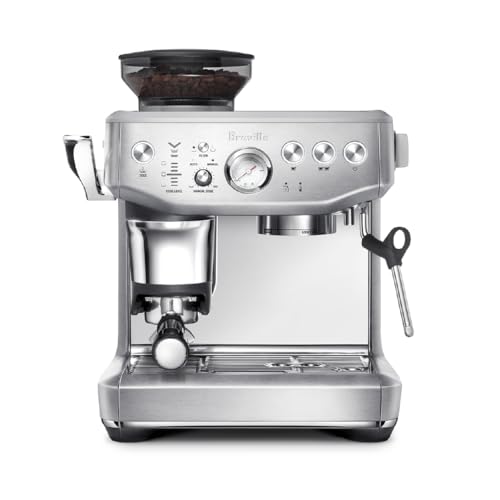
Most people who buy a first serious espresso machine face the same trade-off: a super-automatic that does everything at the push of a button, or a semi-automatic that makes better coffee but asks for skill. The Breville Barista Express Impress (model BES876) is built to narrow that gap. It keeps the manual workflow of a real espresso machine, with a portafilter, a manual steam wand and a grinder you adjust yourself, and it automates the two steps that trip up beginners most: dosing and tamping. This page goes through what Breville publishes about the machine, who will get the most out of it, and where another model on this site is the smarter pick. For the full field, see our ranking of the best espresso machines of 2026.
We have not handled this machine and take no measurements of our own. Everything below comes from Breville’s published specifications and general knowledge of how this kind of machine works.
What Makes the Impress Version Different
The Barista Express line has been a staple of US kitchens for years. The Impress version adds the Impress Puck System, which Breville describes as assisted tamping. According to Breville, the system applies a constant 22 lb of force and finishes with a 7-degree barista twist. A traditional tamp is where most beginners get inconsistent results: too light, too heavy, or crooked. Handing that step to the machine removes one variable while you learn the others.
The second addition is dose memory. Breville says the machine remembers the last dose and tamp outcome and adjusts the next dose accordingly. Its page cites 18 g as an ideal dose and an 18 to 22 g range. In plain terms, if one shot comes out with too much or too little coffee in the basket, the machine nudges the next grind in the right direction. That is a gentle, practical form of guidance that does not hide how espresso works.
Grinder and Beans
The built-in grinder is a conical burr unit with 25 grind settings, according to Breville. A grinder in the same body as the machine is the main reason to buy this model over a pump-only machine: you avoid buying, placing and powering a separate grinder, and you always grind straight into the portafilter. The trade-off is that the grinder is part of the machine. If it ever needs service, the whole unit does, and you cannot upgrade it independently.
Grind setting is the main lever for dialing in. A shot that runs too fast and tastes sour usually needs a finer setting; a shot that crawls and tastes bitter usually needs a coarser one. With 25 steps, there is enough room to work with most roasts. Fresh whole beans make a noticeable difference, so plan to buy beans in small bags and store them airtight at room temperature, away from the stove and sunlight.
How It Brews
According to Breville, the machine uses a 15 bar Italian pump with low-pressure pre-infusion followed by 9 bar extraction. Pre-infusion gently wets the puck before full pressure arrives, which helps water flow evenly through the coffee. The heating system is Thermocoil with PID temperature control, and Breville lists a water delivery temperature of 200°F. Those are the same ideas used in much more expensive machines, packaged for a home counter.
The portafilter is 54 mm stainless steel, and the box includes single wall and dual wall baskets in one-cup and two-cup sizes. Single wall baskets are for freshly ground beans and give you the most control. Dual wall baskets are more forgiving of grind and dose variation, which is why many new owners start there and move to single wall once they are comfortable.
Milk and Steam
This machine has a manual steam wand. Breville describes it as powerful and capable of microfoam suitable for latte art. Manual means you hold the pitcher, position the tip, listen for the right sound and stop at the right temperature. That is a skill that takes a few weeks of daily practice, but it is also the part of the hobby many people enjoy most. A 16 oz stainless steel jug is included, according to Breville, along with a steam wand cleaning tool.
If you want milk drinks made entirely by the machine, this is not it. The Breville Bambino Plus uses an automatic wand with adjustable temperature and texture, and super-automatics such as the De’Longhi Magnifica Evo make milk drinks at the touch of a button.
Daily Workflow
A typical morning looks like this: fill the hopper and water tank as needed, lock the portafilter into the grinder cradle, grind and let the machine dose, let it tamp, lock the handle into the group head and start the shot. While it brews, steam the milk. When you are done, knock out the puck, rinse the portafilter and wipe the steam wand right away so milk does not dry on it. From cold, a semi-automatic machine needs a few minutes to be ready, so build that into your routine.
Because every step happens at the counter, this machine suits people who view the ritual as part of the appeal. If you want to press one button and walk away, look at the super-automatic options instead.
Cleaning, Descaling and Maintenance
Breville includes cleaning tablets, a cleaning disc, a cleaning brush, descale powder, a steam wand cleaning tool and a water filter holder with filter in the box, according to its product page. Those items cover the routine jobs: backflushing the group head with the disc and tablet, brushing the grinder area, clearing the steam wand and descaling when the machine asks. The page does not give a step-by-step procedure, so keep the instruction manual handy and follow it exactly.
Hard water is hard on any espresso machine. If your tap water is hard, a filter and regular descaling will do more for the machine’s lifespan than anything else you can buy. Breville’s page links to a warranty section but does not state the warranty length, so check the current terms before you order.
Breville lists the machine at 16.6 inches wide, 14.4 inches deep and 12.2 inches tall. That is wider than the compact machines on this site, and you will want clearance above it for filling the bean hopper. Breville’s page does not list weight, water tank capacity or electrical ratings, so confirm those with Breville or on the box. Like most home espresso machines sold in the US, it is designed for a standard household outlet, but check the label for UL or ETL marks and avoid sharing the outlet with other high-wattage appliances such as a toaster oven or kettle.
Who Should Buy It
- You want to start from whole beans and learn real espresso without buying a separate grinder.
- You are curious about latte art and are willing to practice steaming milk.
- You like the idea of guided tamping and dosing while you build skills.
- You drink espresso or milk drinks daily and will use the machine enough to justify the setup time.
- You have counter space for a full-size machine.
Who Should Look Elsewhere
- You want one-touch milk drinks. A super-automatic such as the De’Longhi Magnifica Evo is a better match.
- Your counter is small or you share a kitchen. The Breville Bambino Plus is much narrower, though it has no grinder.
- You want to replace a grinder separately in the future or upgrade parts over time. A machine with a separate grinder gives more freedom.
- You do not want to clean after every drink. Any semi-automatic requires it.
How It Compares
Within this site, the Barista Express Impress is the middle path between the manual-heavy and the fully automatic. Against the Bambino Plus, you gain a grinder and assisted tamping and lose compactness and automatic milk. Against a super-automatic, you gain control and, for many drinkers, a higher ceiling on cup quality, but you give up convenience. Our comparison of the best espresso machines lays out every model side by side.
Bottom Line
The Barista Express Impress is a sensible first serious espresso machine for someone who wants to learn. The grinder, assisted tamping and dose memory remove the most frustrating beginner problems, while the manual steam wand keeps the door open for real milk skills. If you want that learning curve, it is the model we rank first. Use the link below to see current configuration and price on Amazon.
See price on Amazon
Sources