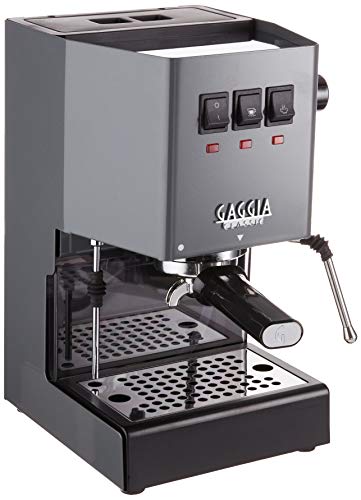
The Gaggia Classic Evo Pro belongs to a family of Italian manual espresso machines that home enthusiasts have used and modified for decades. It has a professional-style portafilter, a steam wand and a short list of controls. It does not have a grinder, a screen or automatic milk. Its appeal is that you learn how espresso works by doing it. This page summarizes what Gaggia says about it, who it suits, and who should look at a different machine in our espresso machine ranking.
We have not handled this machine and take no measurements of our own. Our source is Gaggia’s US operating instructions for the RI9380 model. Because we did not read Gaggia’s product page, we do not quote dimensions, tank size, boiler details or pressure figures.
A Note on the Name
The Amazon listing is titled Gaggia RI9380/51 Classic Evo Pro. Gaggia’s US manual for the RI9380 is titled Classic Pro, and Gaggia has sold the Classic line under several similar names. If you are comparing specs you find elsewhere, match the model code (RI9380) and not just the name.
What Kind of Machine It Is
The Classic is a semi-automatic in the old sense: a pump pushes water through the coffee, and you decide the dose, the tamp and when to stop. There are three main controls: a brew button, a steam button and an on/off button, along with a steam and hot water knob. Indicator lights tell you when the machine is at coffee temperature and at steam temperature.
Gaggia’s own manual sets the tone: the machine must be very hot, the filter holder must stay in place to keep the brew unit at an even temperature, the coffee must be ground finely but not too finely, and the right amount must be pressed with the right pressure. That is a fair summary of the whole experience. It rewards care and punishes shortcuts.
Grinding: The Part You Have to Buy
There is no grinder in this machine, and that is the main cost to plan for. Gaggia’s manual says pump espresso machines need finely ground coffee, that a burr grinder is preferable to a blade grinder because a blade grinder produces irregular grounds and too much powder, and that it is ideal to grind just before use. It also says to store coffee in an airtight container in a cool, dry place.
Practically, a budget burr grinder will work, but espresso needs fine, repeatable steps. A grinder with coarse steps makes it hard to dial in a shot. If you do not want to buy a grinder, you can ask a coffee roaster to grind beans for espresso and use them within a week or two, though flavor fades quickly. If you want grinder and machine in one box, look at the Breville Barista Touch Impress in our ranking.
Filters: Two Ways to Start
Gaggia lists two filters in the US manual. The first is the Crema Perfetta filter for 1 or 2 cups, which comes installed on the filter holder. It is designed to give an espresso with crema even on first use, and the manual says it must be used only with the frothing jet device. It also warns that using it without the device can make the machine squirt coffee out and cause burns. The second is a traditional filter for 2 cups, like those in professional bar machines, which the manual says needs manual skill and experience.
Gaggia’s advice is to start with the Crema Perfetta filter and move to the traditional one once you have the skills. That is sensible. The traditional basket shows every flaw in your grind and tamp, which is a good teacher and also a frustrating one for the first few weeks. The manual’s recipe is simple: one scoop of coffee per cup using the supplied scoop, pressed evenly with the supplied tamper, with any grounds cleaned from the rim before you lock the holder in.
First Use and Routine
Before first use, or after two weeks of inactivity, the manual has you prime the circuit by running water through the brew unit, then run the tank through with the filter holder installed, discard that water and rinse the holder. Do not press the brew button without priming first.
A normal drink goes like this: switch on, wait for the temperature light with the filter holder installed, grind and dose, tamp, lock in, brew. Gaggia says to use only cold water in the tank and to avoid caramelized or flavored beans. The manual also says to clean the holder and filters, and warns against putting the pressurized filter holder in the dishwasher.
Milk and Steaming
The Classic has a hot water and steam wand with a rubber tip, controlled by a knob. The manual’s cappuccino routine is to use cold whole milk in a stainless steel pitcher, press the steam button, wait for the steam temperature light, open the knob slowly and keep the steam nozzle in contact with the milk and not the foam. It limits continuous steam to 60 seconds, since longer can empty the boiler, in which case you have to prime the circuit again. The manual also notes that the steam wand gets very hot, and you should move it by the rubber tip.
Because the machine has one boiler, you cannot brew and steam at once. The manual tells you to lower the boiler temperature by dispensing hot water from the brew unit before making another espresso, or the coffee may taste burnt. Plan on a slower rhythm: a latte takes a few minutes, and two lattes in a row take patience. If you steam milk for guests regularly, a machine with faster recovery will frustrate you less. The Breville Bambino Plus in our ranking heats and steams more quickly and textures milk automatically.
Cleaning and Descaling
Cleaning the Classic means emptying the drip tray, washing the grill, tank, filters and holder, and wiping and purging the steam wand after each use. Gaggia’s manual says to clean the steam nozzle under running water and clear the nozzle hole with steam.
Descaling is a schedule you should take seriously. The manual says descaling should be done every 2 months, with Gaggia’s descaling product only, and that you must not use vinegar or other agents. A full descaling cycle includes letting the solution work for about 20 minutes and rinsing the circuit. In hard-water areas, using bottled or purified water helps, and the manual recommends it for taste.
Who Should Buy It
- You want to learn espresso by doing it, and you enjoy the process.
- You are willing to buy a quality burr grinder.
- You like a simple machine with few parts that you can understand and maintain.
- You want a machine that suits a long-term hobby and can grow with your skills.
- You do not need automatic milk, a screen or presets.
Who Should Look Elsewhere
- You want the machine to grind, dose and texture milk for you. A super-automatic like the Jura E8 handles those steps.
- You want to start with zero learning curve. A pod machine like the Nespresso Vertuo Pop+ is simpler.
- You want the cheapest way to try espresso. The De’Longhi Stilosa costs less, though it offers less to grow into.
- You make several milk drinks back to back.
- You want a machine with a built-in grinder, so you buy one box instead of two.
Bottom Line
The Gaggia Classic Evo Pro is for people who want to learn espresso as a craft. It has few controls and few frills, and it asks you to supply a grinder, practice and a regular maintenance routine. If that sounds like a hobby, it is a durable and rewarding place to begin. If it sounds like a chore, choose a machine that automates more.
You can see the current price and availability on Amazon. To compare it with the rest of our list, return to the espresso machine ranking.
Sources