Best Espresso Machine for Beginners: How to Choose
Picking a first espresso machine: pressurized vs. non-pressurized baskets, whether you need a grinder, dose basics, and four beginner-friendly models.
At a glance
A first-time buyer who wants to start from whole beans should look at the Breville Barista Express Impress, which has a grinder and assisted tamping. The Ninja Luxe Café Premier coaches grind and dose and adds drip coffee. For a small kitchen, the Breville Bambino Plus is compact but needs a separate grinder.
A first espresso machine is easy to get wrong. The listings show 15 bars of pressure, touchscreens and steam wands, and none of that tells a new buyer what the first month will feel like. In practice, three things decide whether a beginner ends up with good lattes or a machine in the closet: how the coffee gets ground, how forgiving the basket is, and how much of the dosing and milk work the machine takes over.
This guide covers those three questions first, then matches four models on this site to four kinds of beginners. We have not handled any of these machines ourselves. We compared what the manufacturers publish, as summarized in each profile on this site.
Start With the Grinder Question
Espresso needs a fine, consistent grind, and pre-ground coffee from a supermarket shelf is usually neither fine enough nor fresh enough. That is why the grinder, more than the machine, is the line that separates frustrating first weeks from encouraging ones.
You have three realistic routes:
- A machine with a built-in grinder. One purchase, one footprint, and the beans go straight into the portafilter. The trade-off is that you cannot upgrade the grinder separately.
- A machine without a grinder, plus a separate burr grinder. This is the long-term route many home baristas take. Count the grinder’s cost and counter space from day one. Gaggia’s own manual, which we cover in its profile, says a burr grinder is preferable to a blade grinder because a blade produces irregular grounds and too much powder, and that coffee is best ground just before use.
- Beans ground for espresso at a roaster, or ESE pods. This works for a week or two, until the flavor fades. It is a stopgap, not a plan.
A grinder with coarse steps makes it hard to dial in a shot, so if you buy one separately, look for fine, repeatable adjustments.
Pressurized vs. Non-Pressurized Baskets
The basket is the metal cup in the portafilter that holds the coffee, and it changes how forgiving the machine feels. According to Breville, a pressurized (dual-wall) basket has an inner wall with many holes inside an outer wall with a single small hole at the base. That hole creates back pressure, which Breville says helps offset inconsistencies such as an uneven tamp or the wrong grind size. Breville says these baskets suit beginners and entry-level machines, at the cost of some control and possibly a less full-bodied cup.
A non-pressurized (single-wall) basket has holes across the entire base, so a properly tamped, compact puck must supply the resistance. Breville says it needs finely ground, evenly tamped coffee, takes practice and trial and error, and can be messy if the grind is too coarse or the tamp uneven. When dialed in, it can give rich flavor and crema.
The practical advice for a new owner:
- Start with the forgiving basket if you buy pre-ground coffee or use a grinder that cannot make small steps.
- Move to single-wall baskets once your grind and tamp are consistent.
- Check which baskets come in the box. The Breville Bambino Plus profile notes that Breville includes both single-wall and dual-wall baskets in 1-cup and 2-cup sizes, and advises dual-wall baskets with pre-ground coffee.
Dose, Yield and Dialing In
Three terms come up in every beginner video. Dose is the weight of ground coffee in the basket. Yield is the weight of liquid espresso in the cup. Grind setting is the lever you adjust to make the shot run faster or slower.
You do not need to memorize ratios. What matters is repeatability: the same dose each time, then one change at a time. Breville’s page for the Barista Express Impress cites 18 g as an ideal dose, with an 18 to 22 g range, and the Bambino Plus portafilter is designed for 18 g, according to Breville. A kitchen scale that reads to 0.1 g is an inexpensive way to see what is really in the basket, unless the machine has a scale built in.
Then taste:
- A shot that runs too fast and tastes sour usually needs a finer setting.
- A shot that crawls and tastes bitter usually needs a coarser setting.
- Change only one variable per shot, and give the next shot a chance to settle.
A fresh bag of a different roast often needs a small adjustment, so dialing in is a recurring habit, not a one-time setup.
Milk: Manual Wand or Automatic
Steaming milk is the other skill that frustrates beginners. A manual wand teaches transferable technique, but plan on a few weeks of practice. An automatic wand or milk preset gives consistent results while you learn, but it does not produce latte art. If pouring hearts is a goal, a manual wand is the better teacher. If you just want a reliable latte, automation is a sensible shortcut.
Cleaning and Water
Every semi-automatic needs a short routine after each session: rinse the portafilter and baskets, knock out the puck, and wipe and purge the steam wand so milk does not dry in the tip. Descaling is the maintenance job people forget. The U.S. Geological Survey classifies water above 180 mg/L as calcium carbonate as very hard, and notes that heating hard water leaves calcium carbonate deposits that can shorten equipment life. If your water is hard, use a filter and descale on the schedule in the manual.
Four Machines for Four Kinds of Beginners
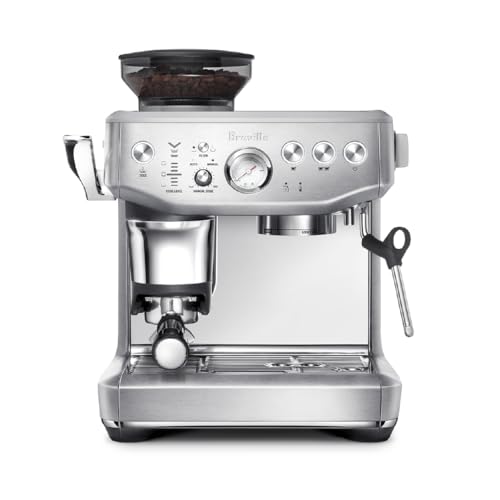
Breville Barista Express Impress: For the Beginner Who Wants to Learn From Whole Beans
A built-in grinder, assisted tamping and dose memory remove the steps that trip up most newcomers, while the manual steam wand keeps real milk skills on the table.
According to Breville, the Impress Puck System applies a constant 22 lb of tamping force and finishes with a 7-degree twist, and the machine remembers the last dose and adjusts the next one. The grinder is a conical burr unit with 25 settings, and the pump delivers low-pressure pre-infusion followed by 9 bar extraction. This is the model we rank first for a person who wants to learn real espresso without buying a separate grinder. The cost is counter space: Breville lists it at 16.6 inches wide, 14.4 inches deep and 12.2 inches tall. Details are in the Barista Express Impress profile.
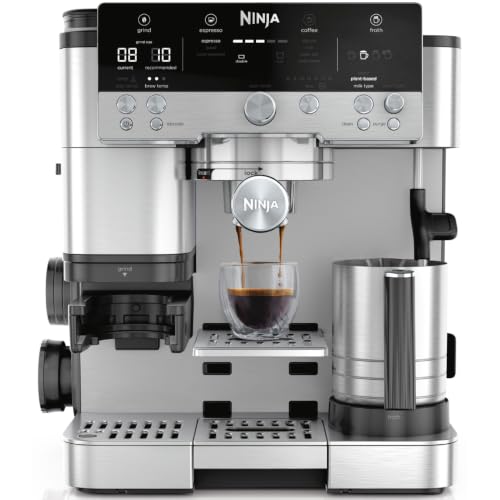
Ninja Luxe Café Premier: For the Household That Also Drinks Drip Coffee
Guided grind and dose recommendations, hands-free milk presets, plus drip coffee and cold brew, for a household where not everyone wants espresso.
SharkNinja describes a 3-in-1 machine for espresso, drip coffee and cold brew, with a Barista Assist system that guides users from grind-size recommendations through weight-based dosing, and a Dual Froth System with four presets. Think of the guidance as feedback on what changed when a shot goes wrong. SharkNinja’s launch announcement says little about dimensions, so confirm size and power on the product page before choosing a spot. See the Ninja Luxe Café Premier profile.
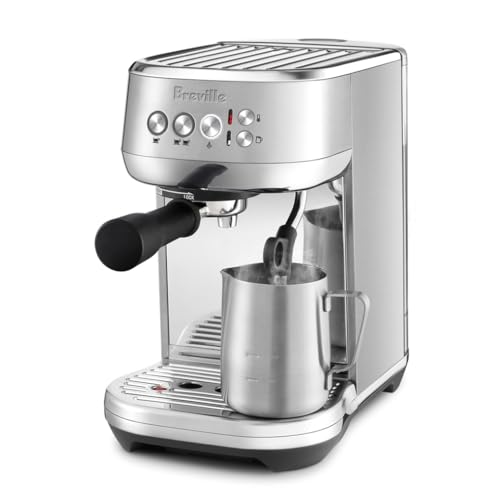
Breville Bambino Plus: For a Small Kitchen and a Grinder You Will Add
A narrow semi-automatic with an automatic steam wand and a fast start; budget for a separate burr grinder.
Breville lists the Bambino Plus at 11.9 inches wide, 7.4 inches deep and 14.3 inches tall, with a ThermoJet heating system that is ready in about 3 seconds, according to Breville. The automatic wand offers 3 milk temperatures and 3 texture levels. The catch is the missing grinder, so count that purchase before you decide. Read the Bambino Plus profile for the full picture.
De’Longhi Stilosa: For the Tightest Budget
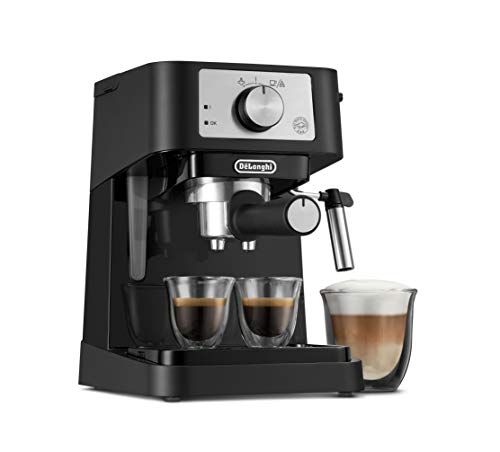
An entry-level manual machine with a portafilter and steam wand for someone who wants to try real espresso before spending more.
According to De’Longhi, the Stilosa has a 15 bar pump, a stainless steel boiler, a 33.81 oz tank and a manual frother, and it lists ESE pod compatibility, which lets you skip grinding and tamping while you learn. De’Longhi’s page does not describe the filter design, so check the manual to see whether the filters are pressurized. There is no grinder and no automation, so this is a stepping stone, not a finished setup. See the De’Longhi Stilosa profile.
Which One Fits You
- You want to learn the craft from whole beans: the Barista Express Impress.
- You want guidance plus drip and cold brew: the Ninja Luxe Café Premier.
- You have little counter space and will buy a grinder: the Bambino Plus.
- You want the lowest-cost way to try a portafilter: the Stilosa, with a plan for a grinder or pods.
If you would rather skip the learning curve entirely, a super-automatic or pod machine is a different category. Our ranking of the best espresso machines compares every model on this site.
Sources
Frequently asked questions
Do I need a separate grinder for my first espresso machine?
Only if the machine does not have one built in. The Breville Barista Express Impress and the Ninja Luxe Café Premier include grinders. The Breville Bambino Plus and the De'Longhi Stilosa do not, so you would need a burr grinder with fine adjustments, or beans ground for espresso at a roaster.
What is the difference between a pressurized and a non-pressurized basket?
According to Breville, a pressurized (dual-wall) basket has a single small exit hole that creates back pressure, which helps offset an uneven tamp or the wrong grind size. A non-pressurized (single-wall) basket has holes across the base, so the packed coffee itself must provide the resistance. Breville points beginners to the first type and experienced home brewers to the second.
How long does it take to get decent shots?
Plan on a few weeks of daily practice if you use a semi-automatic with a manual steam wand. Machines that guide your dose or tamp shorten the first stretch, but you still have to taste each shot and adjust the grind.
Is a pod machine a better start than a semi-automatic?
A pod machine has no learning curve, but you are limited to the capsules it reads, and it does not make a portafilter shot. If you want to learn how espresso works, a semi-automatic is the better teacher.
What should I do if my shot tastes sour or bitter?
As a rule of thumb, a shot that runs fast and tastes sour usually needs a finer grind, and a shot that crawls and tastes bitter usually needs a coarser one. Change one thing at a time and taste after each change.
Do I need to descale a beginner machine?
Yes. Scale builds up faster in hard water, so follow the manual's descaling schedule and use filtered water if your tap water is hard.