Best Small Espresso Machine for an Apartment or Dorm
Footprint in inches, 120 V outlet limits, wattage, noise and dorm appliance rules: how to choose a small espresso machine for an apartment, with four models.
At a glance
For a small apartment kitchen, the Breville Bambino Plus is the narrowest real espresso machine on this site, though it needs a separate grinder. The Nespresso Vertuo Pop+ suits a dorm or desk with capsules only, and the Philips 3300 LatteGo adds easy milk cleanup and quieter grinding.
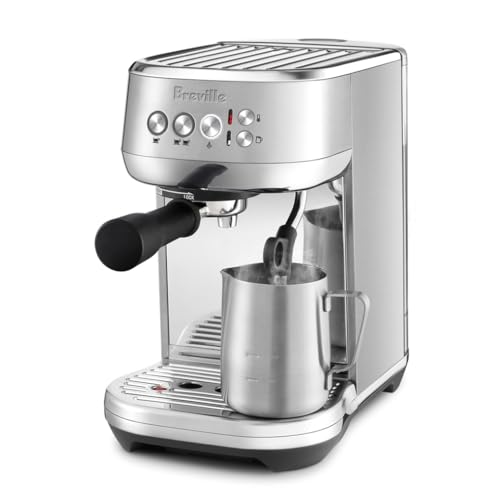
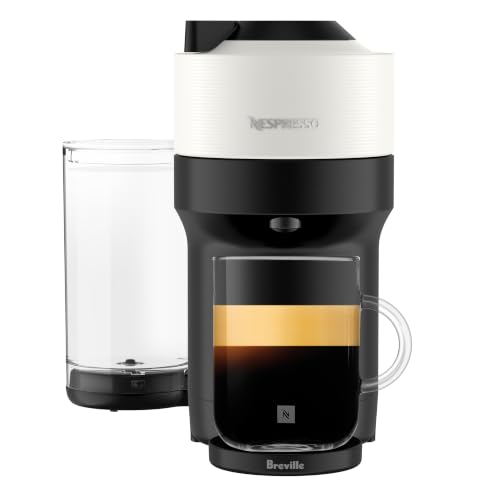
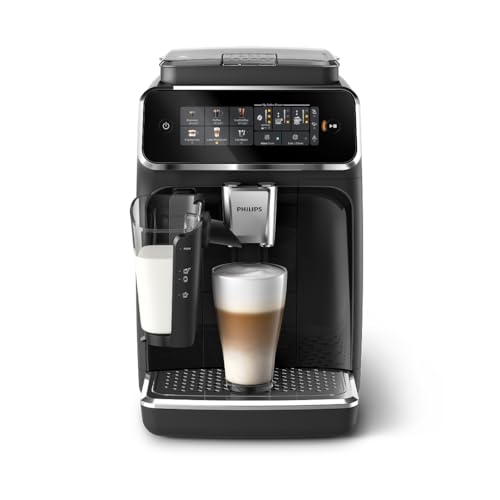
Small-space espresso comes down to four numbers: inches, watts, decibels and rules. A machine that looks tidy in a photo can be 14 inches tall with a hopper that needs headroom, or pull more current than a dorm allows. This guide walks through what to check in an apartment, a studio or a residence hall, and then matches four compact options from this site.
We have not handled any of these machines. The figures below are the ones the makers publish, and we flag what to confirm before buying where a number is missing.
Measure the Spot First
Start with a tape measure, not a product page. For each candidate spot, write down three numbers: the width of the free counter, the depth from the wall to the counter edge, and the height from the counter to the underside of the cabinet. Then add allowances:
- Height: a bean hopper or a water tank lid needs room to open, and many machines are filled from the top. A machine that fits under a cabinet by half an inch is a machine you will carry to the sink every day.
- Depth: the drip tray slides out toward you, and the portafilter handle sticks out in front. Leave at least a few inches of working room.
- Side access: some tanks lift out from the side or back. Check how yours is filled.
Here is what the makers publish for the four models in this guide:
| Model | Listed size (W x D x H) | Grinder |
|---|---|---|
| Breville Bambino Plus | 11.9 x 7.4 x 14.3 in | None |
| De’Longhi Stilosa | 13.5 x 8.07 x 11.22 (no units listed) | None |
| Nespresso Vertuo Pop+ | 8.6 x 14 x 10.4 in | None (capsules) |
| Philips 3300 LatteGo | Not listed by Philips | Built in |
A machine without a grinder saves counter space only until you add a grinder. If you buy a separate burr grinder, count its footprint too.
Power: What a 120 V Outlet Can Give You
Home espresso machines sold in the US are built for standard 120 V outlets. The practical question is how much of a circuit the machine takes. Amps equal watts divided by volts, so a 1,100 W machine draws roughly 9 A, and a 1,500 W machine draws roughly 12.5 A. A typical household branch circuit is rated at 15 A, which at 120 V is 1,800 W in total, shared by everything else on that circuit. That is arithmetic, not a rule about your wiring. Apartments differ, and kitchens and living rooms are sometimes on the same breaker.
Practical habits:
- Do not run the machine at the same time as a microwave, toaster, kettle or space heater on the same circuit.
- Plug it directly into a wall outlet. OSHA’s electrical page lists improper use of extension and flexible cords among the common causes of electrical injuries, and heating appliances are a poor match for light-duty cords.
- Look for a UL or ETL mark on the label.
- If a breaker trips while the machine heats, move it to another outlet on a different circuit and do not rely on a power strip.
Wattage figures from the makers: De’Longhi lists the Stilosa at 120 V, 60 Hz and 1100 W, and Nespresso’s manual lists the Vertuo Pop+ at 1500 W for the US and Canada. Breville and Philips do not list wattage, so confirm it on the box or in the manual.
Dorm Rooms: Read Your School’s Page
Dorm rules vary more than any other factor in this guide, and they can change building by building. Two real examples show the range:
- Iowa State says on its prohibited items page that coffee makers, Keurig-type single-serve coffee pots, electric water kettles and espresso machines can be used in residence hall rooms and apartments. It also lists personal space heaters as prohibited and requires surge protectors to be UL listed with 15-amp breaker protection.
- Appalachian State lists, on its housing policies page, any appliance exceeding 1200 watts or 10 amps as prohibited, including single-serve coffee makers. It does not name espresso machines, so that wattage rule is what a student would have to check against.
Under a 1200 W / 10 A limit, a 1,500 W machine would be over the line, and a 1,100 W machine would sit under it. We checked only those two pages. Do not assume your school follows either one, and ask housing in writing if your machine is not named.
Noise for the Neighbors
In a small apartment, the loudest part of an espresso routine is usually the grinder, followed by the pump. Three ways to cut the noise:
- Choose a machine without a grinder if you can live with pods, or with a separate grinder you run at a reasonable hour.
- Grind in short sessions and avoid early mornings if you share a wall.
- Consider a quieter bean-to-cup design. Philips says its SilentBrew process makes 40% less noise than earlier models and that the machine has Quiet Mark certification. That is a manufacturer claim about earlier Philips models, and it is not a promise of silence.
Four Compact Options
Breville Bambino Plus: The Narrowest Real Espresso Machine on This Site
A semi-automatic about 12 inches wide with a fast start and an automatic steam wand; plan for a separate burr grinder.
The Bambino Plus keeps a real 54 mm portafilter and a pump with low-pressure pre-infusion, according to Breville, while its ThermoJet system is ready in about 3 seconds. The automatic wand has 3 temperatures and 3 texture levels. Breville’s page does not list weight, tank size or electrical ratings, so check the box. The Bambino Plus profile covers the grinder choices.
De’Longhi Stilosa: A Low-Cost Manual Machine for a Shelf
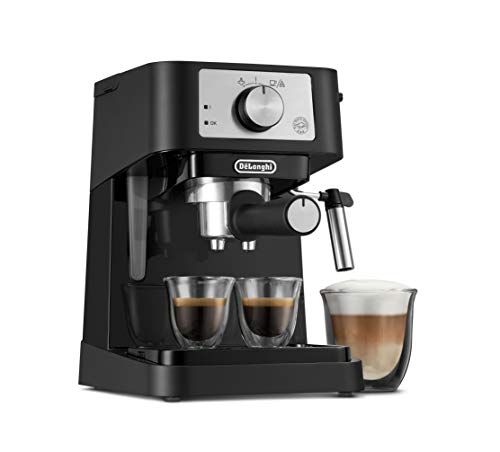
A small manual espresso machine with a 33.81 oz tank, a portafilter and a steam wand, for a first machine in a tight space.
De’Longhi lists the Stilosa at 8.61 lb, with a two-level cup holder that fits a mug up to 4.29 inches tall. It has no grinder or automation. A single small boiler needs time to recover between shots and steam, so it suits one drink at a time. See the De’Longhi Stilosa profile.
Nespresso Vertuo Pop+: For a Desk, a Dorm Shelf or No-Fuss Mornings
A capsule machine at 8.6 inches wide with no grinder, portafilter or steam wand to clean.
According to Nespresso’s manual, the machine heats in 30 seconds, turns itself off after 2 minutes of non-use, weighs 7.9 lb and has a 25.4 fl oz tank. It reads Vertuo capsules only, and its 1500 W rating matters for dorms with a wattage cap. This ASIN has no milk system. Read the Vertuo Pop+ profile for capsule and recycling notes.
Philips 3300 LatteGo: For Quieter Bean-to-Cup Lattes
A bean-to-cup machine with a tube-free milk system and a quieter-grinding design, for an apartment where milk cleanup and noise matter.
Philips says the LatteGo milk container can be cleaned in as little as 10 seconds, and the AquaClean filter allows up to 5,000 cups without descaling when changed on prompt. Philips’ page gives no dimensions or wattage, so confirm the size against your cabinet space before you order. See the Philips 3300 LatteGo profile.
Picking by Space
- Under a cabinet or on a bookshelf: the Stilosa or the Vertuo Pop+, after checking the height.
- A galley kitchen where you want a portafilter: the Bambino Plus, with a grinder plan.
- A shared wall and a milk-drinking household: the Philips 3300, after confirming it fits.
- A dorm with a wattage cap: whichever machine your school’s page allows, though of the two wattage figures published, the Stilosa’s 1,100 W is the lower.
Compare every model in our ranking of the best espresso machines.
Sources
Frequently asked questions
How much counter space does a small espresso machine need?
According to their makers, the compact models here with listed inch dimensions are 8.6 to 11.9 inches wide and 7.4 to 14 inches deep. De'Longhi lists the Stilosa's size without units. Add clearance above for filling the tank, and room to pull out the drip tray. Measure under your cabinets before you order.
Can I plug an espresso machine into a regular apartment outlet?
The machines on this site are listed by their makers for 120 V household use. Watts divided by 120 gives the amps, so a 1,500 W machine draws about 12.5 A. Avoid running it at the same time as other heavy appliances on the same circuit, and plug it into the wall, not a power strip.
Are espresso machines allowed in dorm rooms?
It depends on the school. Iowa State's housing page lists espresso machines among items usable in residence hall rooms and apartments, while Appalachian State bans any appliance over 1200 watts or 10 amps. Read your own school's prohibited-items page, and ask housing if an espresso machine is not named.
Which type is quietest for neighbors?
Machines that grind beans add the loudest sound. Philips says its SilentBrew design makes 40% less noise than earlier models and holds Quiet Mark certification, but no grinder-equipped machine is silent. A pod machine has no grinder, and a semi-automatic without one is quiet apart from the pump.
Do I need a grinder for a small setup?
Not with a pod machine or a bean-to-cup machine. The Breville Bambino Plus and the De'Longhi Stilosa have no grinder, so a separate burr grinder takes counter space back from the machine's small body.
How often should I clean a small machine?
Rinse removable parts and empty the drip tray often, wipe and purge a steam wand right after use, and descale on the maker's schedule. Hard water speeds up scale.